


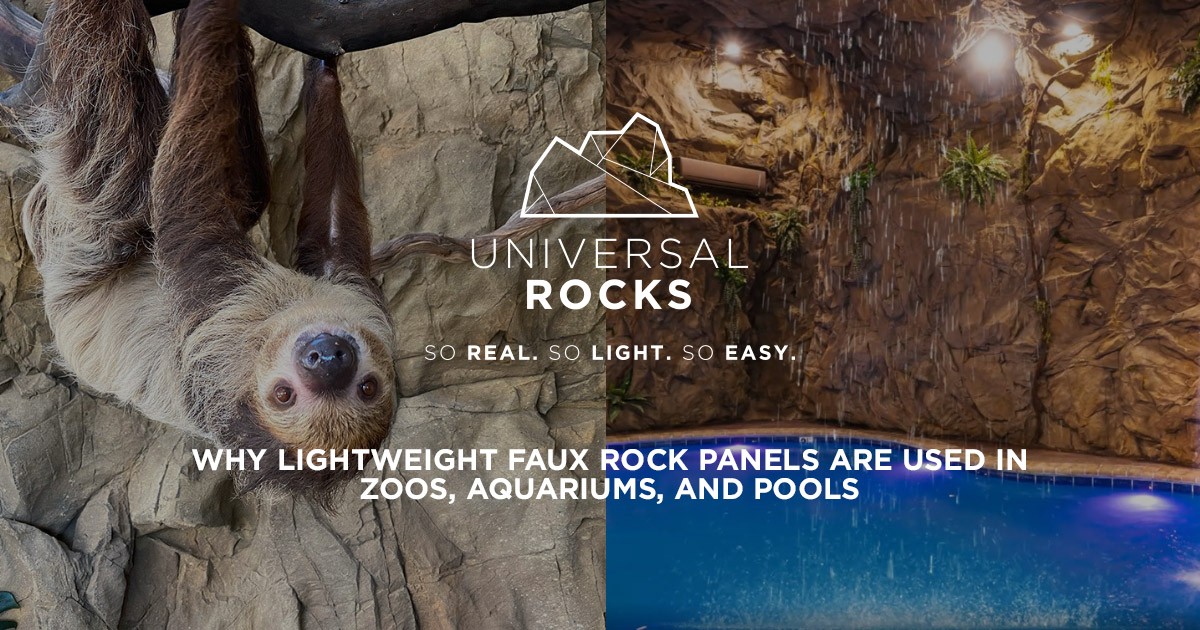
Designing zoo habitats and aquarium environments takes more than good aesthetics. These spaces need to look natural while standing up to constant water exposure, animal interaction, and everyday use. That's why many facilities turn to faux rock panels for zoos and aquariums. Universal Rocks' lightweight panels deliver the appearance of real stone without the heavy structural load, permanence, or installation challenges of traditional cement rockwork.
These environments require durability, flexibility, and efficiency — and faux rock panels help support all three.
What Are Faux Rock Panels Made Of?
Universal Rocks' faux rock panels are made using polyurea with a polyurethane foam backing. Polyurea is known for its toughness and is often compared to the protective coating used in truck bed liners.
Instead of relying on surface paint, crushed natural rock sands are embedded directly into the panel surface. This creates authentic texture, natural color variation, and long-lasting realism. The result is a material that looks like natural stone but performs very differently from traditional rockwork, especially in controlled habitats and aquatic environments.
Why Are Faux Rock Panels Used in Zoo Habitats?
Zoo habitats need to feel natural while still being practical to maintain and update over time. Faux rock panels help make that possible.
Creating Natural-Looking Environments
Facilities use faux rock panels to shape enclosure walls, backdrops, and terrain features that resemble natural landscapes. These panels are also part of functional habitat elements like:
- Climbable rock features
- Reptile basking ledges
- Faux trees and vines
Because they're lightweight, they can be installed in spaces where cement rock would introduce too much structural load, especially in indoor or retrofitted environments.
Supporting Everyday Animal Interaction
Zoo environments are active by nature. Animals climb, lean, perch, and explore throughout the day, so habitat materials need to support regular interaction. Faux rock panels are often paired with additional features to help create functional and engaging spaces, including:
- Climbing rocks
- Drinking or cooling ponds
- Feeding and watering bowls
In areas where animals frequently perch or apply pressure, installations can be reinforced or integrated with other materials to improve durability while maintaining a natural appearance.
Making Habitat Updates Easier
One of the biggest advantages is flexibility. Unlike cement rockwork, faux rock panels and habitat features can be removed or replaced when an exhibit needs to evolve.
This makes it easier to:
- Refresh exhibits
- Adjust layouts
- Support changing species needs
Habitats can evolve without full reconstruction.
How Do Faux Rock Panels Perform in Aquatic Environments?
Water exposure is a constant factor in aquariums and water features, making material performance especially important. Faux rock panels are designed to withstand wet conditions and can be fully submerged without deteriorating. Because of this, they are commonly used for aquarium backdrops, enclosure ponds, spillway-style water features, and submerged terrain elements. Their resistance to moisture helps preserve both structural integrity and visual realism over time.
How Do Lightweight Panels Improve Installation?
Compared to cement rock construction, lightweight panels allow for quicker installation with less disruption. They can be installed in flexible form for visual realism or reinforced where additional rigidity is needed. This allows installations to be tailored to how the space will actually be used. Facilities often choose faux rock panels because they install faster, reduce construction disruption, and allow for future updates.
Why Facilities Choose Faux Rock Panels
Zoo designers, aquarium planners, and habitat engineers choose faux rock panels because they offer:
- Realistic texture from embedded natural sands
- Reliable performance in wet environments
- Reduced structural weight
- Faster installation timelines
- Compatibility with habitat features like ledges and ponds
- Greater flexibility for future updates
They support spaces that need to look natural but still function day to day.
Build Spaces That Can Evolve with Universal Rocks
Zoo habitats and aquatic environments are always evolving. As animal needs shift or exhibits are refreshed, having flexible design elements becomes incredibly valuable.
Universal Rocks works with zoos, aquariums, and exhibit designers to create naturalistic environments that balance realism with durability. Faux rock panels make it easier to design spaces that perform reliably in wet conditions, install efficiently, and adapt over time.
If you're planning a habitat, exhibit, or aquatic feature, connect with Universal Rocks to learn how faux rock panels can support both today's needs and future flexibility.